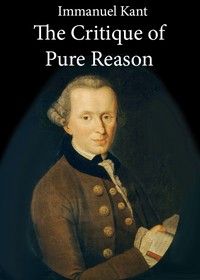
"The Critique of Pure Reason" by Immanuel Kant is a philosophical work published in 1781. Kant investigates the limits and scope of metaphysics, asking how we can know anything before experiencing it. He challenges both rationalist and empiricist traditions, introducing revolutionary ideas about space, time, and knowledge. The central question driving the work is: "How are synthetic a priori judgments possible?" Kant argues this matter is crucial to the survival of human reason itself. (This is an automatically generated summary.)
Así empieza
II. The Human Intellect, even in an Unphilosophical State, is in Possession of Certain Cognitions “à priori”.
III. Philosophy stands in need of a Science which shall Determine the Possibility, Principles, and Extent of Human Knowledge “à priori”
IV. Of the Difference Between Analytical and Synthetical Judgements.
V. In all Theoretical Sciences of Reason, Synthetical Judgements “à priori” are contained as Principles.
VI. The Universal Problem of Pure Reason.
VII. Idea and Division of a Particular Science, under the Name of a Critique of Pure Reason.
… sigue leyendo gratis en el lector inmersivo de Mirrow.
Léelo gratis en Mirrow
The Critique of Pure Reason completo, con atmósfera de vídeo y sonido. Sin descargas.
Más general gratis
- King--of the Khyber Rifles: A Romance of Adventure
Talbot Mundy - De vrouw in de hedendaagsche maatschappij
Herman Bavinck - Der Weltverkehr: Telegraphie und Post, Eisenbahnen und Schiffahrt, in ihrer Entwickelung dargestellt
Michael Geistbeck - Contribucion Para El Estudio de los Antiguos Alfabetos Filipinos
T. H. (Trinidad Hermenegildo) Pardo de Tavera - On the Evolution of Language: First Annual Report of the Bureau of Ethnology to the Secretary of the Smithsonian Institution, 1879-80, Government Printing Office, Washington, 1881, pages 1-16
John Wesley Powell - Introduction à la vie dévote
de Sales, Saint Francis