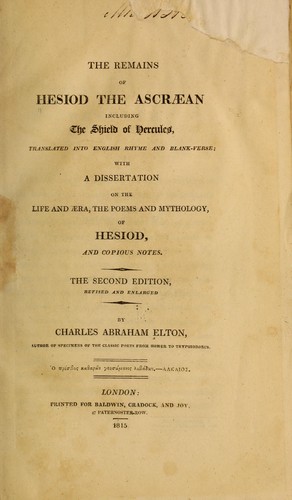
"The Remains of Hesiod the Ascræan, Including the Shield of Hercules" by Hesiod is an archaic Greek epic poem generally dated from the end of the 7th to the middle of the 6th century BCE. The work recounts Heracles and Iolaus's expedition against Cycnus, son of Ares, who challenges Heracles to combat in Thessaly. At its heart lies an elaborate description of Heracles' shield, crafted by Hephaestus, adorned with intricate scenes of weddings, battles, and mythological creatures—a dazzling display of ancient artistry and storytelling. (This is an automatically generated summary.)
Así empieza
The remains of Hesiod are not alone interesting to the antiquary, as tracing a picture of the rude arts and manners of the ancient Greeks. His sublime philosophic allegories; his elevated views of a retributive Providence; and the romantic elegance, or daring grandeur, with which he has invested the legends of his mythology, offer more solid reasons than the accident of coeval existence for the traditional association of his name with that of Homer.
Hesiod has been translated in Latin hexameters by Nicolaus Valla, and by Bernardo Zamagna. A French translation by Jacques le Gras bears date 1586. The earliest essay on his poems by our own countrymen appears in the old racy version of “The Works and Days,” by George Chapman, the translator of Homer, published in 1618. It is so scarce that Warton in “The History of English Poetry” doubts its existence. Some specimens of a work equally curious from its rareness, and interesting as an example of our ancient poetry, are appended to this translation. Parnell has given a sprightly imitation of the Pandora, under the title of “Hesiod, or the Rise of Woman:” and Broome, the coadjutor of Pope in the Odyssey, has paraphrased the battle of the Titans and the Tartarus.[1] The translation by Thomas Cooke omits the splendid heroical fragment of “The Shield,” which I have restored to its legitimate connexion. It was first published in 1728; reprinted in 1740; and has been inserted in the collections of Anderson and Chalmers.
This translator obtained from his contemporaries the name of “Hesiod Cooke.” He was thought a good Grecian; and translated against Pope the episode of Thersites, in the Iliad, with some success; which procured him a place in the Dunciad:
Be thine, my stationer, this magic gift, Cooke shall be Prior, and Co
… sigue leyendo gratis en el lector inmersivo de Mirrow.
Léelo gratis en Mirrow
The Remains of Hesiod the Ascræan, Including the Shield of Hercules: Translated into English rhyme and blank verse; with a dissertation on the life and æra, the poems and mythology of Hesiod, and copious notes. completo, con atmósfera de vídeo y sonido. Sin descargas.
Más drama gratis
- Jane Eyre: An Autobiography
Charlotte Brontë - The Brothers Karamazov
Fyodor Dostoyevsky - The Adventures of Roderick Random
T. (Tobias) Smollett - A Tale of Two Cities
Charles Dickens - That Girl Montana
Marah Ellis Ryan - The Hound of the Baskervilles
Arthur Conan Doyle